SEARCH
News

From the 12th to 18th of January 2026, Cristuru Secuiesc, Romania, became a meeting point for people from across Europe during the Transnational Bootcamp #2, part of the RYSE project.


Gathering 36 youngsters and 6 youth leaders from France, Italy, Spain, Hungary, Portugal, and Romania, the bootcamp created a space for sharing micro-projects, ideas, and lived experiences. Together, participants explored how local initiatives can generate wider impact, particularly in the areas of sustainable development and youth empowerment.

Through Digital Storytelling, participants transformed their projects and personal journeys into meaningful narratives, giving voice to their experiences and highlighting the value of collaboration and active citizenship.

Led by Le Partenariat (France) and supported by partners from Italy (CEFA ETS), Hungary  (Anthropolis), Spain (Jovesolides), Portugal (Aventura MarĂŁo Clube), and Romania  (Asociația de Tineri din Ardeal), RYSE aims to strengthen young people’s employability while deepening their understanding of today’s social, environmental, and ecological challenges.

More than a training, the bootcamp was a shared journey of connection, creativity, and inspiration, carried forward by participants into their local communities.

You can find the short videos HERE.

0

News

New ESC Volunteering Opportunity: Green Growth – Sustainability and Community Action in Transylvania!

We are happy to announce our new European Solidarity Corps (ESC) volunteering project titled Green Growth, an exciting opportunity for young people who want to take action for the environment and contribute to a greener future.

The project aims to support sustainability, raise environmental awareness, and promote the importance of recycling with the participation of 12 international volunteers, both in rural and urban environments.


đŸŒ± What will we do?

During the project, volunteers will take part in hands-on and creative activities, such as:

  • workshops on sustainability and recycling

  • creating short awareness-raising campaign videosc

  • community clean-up campaigns in both rural and small-town areas.

  • cleaning riverbanks, streams and polluted areas in six nearby settlements

Our goal is to involve at least 200 local young participants, offering them valuable learning experiences and encouraging them to become active in protecting their environment.

🌍 What do we offer volunteers?

The project will take place in SzĂ©kelykeresztĂșr (Cristuru Secuiesc), Transylvania, Romania, a culturally rich small town with a welcoming local community.

Volunteers will receive:

✅ accommodation in a modern, well-equipped facility
✅ food allowance
✅ pocket money
✅ travel reimbursement according to ESC rules
✅ health insurance
✅ support from an experienced mentor
✅ non-formal education-based trainings
✅ basic Hungarian language sessions

Two project coordinators will ensure smooth implementation throughout the project.

đŸ‘„ Who are we looking for?

We are searching for motivated young people aged 18–30 who:

  • are interested in sustainability and recycling

  • enjoy teamwork and community engagement

  • are not afraid of getting their hands dirty

  • are open-minded, proactive, and creative

  • can work independently and contribute their own ideas

📅 Important Dates

📌 Application deadline: February 25, 2026
📌 Arrival day: June 3, 2026
📌 Project dates: June 4–18, 2026
📌 Departure day: June 19, 2026

📝 How to apply?

Please send an English CV with a photo and a motivation letter to:

đŸ“© office.ata@gmail.com

and complete the Google Forms application form.
Infopeck: https://drive.google.com/file/d/1m_MEZq0nseGmzJlnt2gzoKXDFRnlq0LA/view?usp=sharing
Application form : https://forms.gle/oKHLd5BQLpdg6uJF6

0

Projects

We are proud to announce the start of SYNERGY, officially “Synergy of practices to counter civic apathy among young people in Central and Eastern Europe”, a new Erasmus+ Capacity Building in the field of Youth project coordinated by us, the Youth Association from Transylvania, and implemented together with partners from Slovakia, Hungary, Moldova, Georgia and Ukraine.

These six civil society organisations will work with young people in both EU Member States and the EU’s Eastern Neighbourhood in order to address one of the region’s most pressing challenges: growing civic apathy among young people who feel disconnected from democratic processes, community life and public decision-making. SYNERGY was created as a direct response to these realities, with the overall aim of strengthening the capacity of youth organisations to counter civic apathy and to promote active civic engagement among young people at local level. 


During its implementation, SYNERGY will map, analyse and document existing practices from the sicx partners that help counter civic apathy and foster civic engagement among young people. These practices will be explored in depth through six international study visits hosted by the project partners, giving participants the chance to observe methods directly in their original context and discuss them critically with peers and local stakeholders. The project will then move into a large testing phase in all six countries, where at least 18 practices will be adapted and implemented locally, reaching at least 1200 young people and 300 stakeholders. The results will be consolidated and shared through a best practices publication, 18 adaptation videos, and national and international dissemination events.   


A strong focus of the project is placed on non-formal education, youth empowerment and stakeholder cooperation. SYNERGY will pay special attention to young people from rural and remote areas, minority communities and other groups facing fewer opportunities. By identifying effective practices, testing them in new contexts and making the results available in six languages, the project will strengthen the partner organisations and will create practical resources that can be used by youth workers, educators, local authorities and other organisations across the region and beyond.  


The first official online kick-off meeting of the partnership will take place on the 15th of January, followed by an in-person meeting in ChiƟinău, Moldova, at the start of February, where partners will review the work plan, align expectations, agree on monitoring and communication procedures, and prepare the upcoming study visits. This marks the beginning of a two-year cooperation process focused on building stronger, more resilient youth organisations and creating better opportunities for young people to participate actively in their communities. 


We are excited to begin this journey together with our partners and to contribute to a region in which more young people feel heard, empowered and ready to shape the future of their communities.

0

News

We are excited to share one of the most important outcomes of our Seminar on Selection, developed together with our international partners over the course of an inspiring week: the Selection Booklet is finally here!

This booklet did not come together overnight. It is the result of a week of collaborative thinking, professional discussions, and the shared experiences of the participating organisations. Inside, we have collected ideas, methods, and practical tips that we already use ourselves or are looking forward to trying out in our future Erasmus+ and ESC projects.

What will you find inside?

📌 How to create an engaging Info Pack:
We don’t only explain what information an Info Pack should include, but also how to make it visually attractive, easy to understand, and motivating for young people, with plenty of examples and illustrations.

📌 Participant selection step by step:
What information should you ask applicants for? Which questions are worth including? What should you pay attention to during the selection process? And what are the key competences of a good selector? The booklet offers practical answers to all of these questions.

📌 An ideal timeline for Erasmus+ and ESC projects:
The booklet guides you through the entire process—from promoting the opportunity and selecting participants to preparing the group and the final days before departure. A well-planned timeline can save organisers a great deal of stress and help avoid misunderstandings.

📌 Ownership: How to make the project truly belong to the participants
This was probably one of the most discussed topics during the seminar. The booklet presents simple, practical ideas for involving young people already during the preparation phase, giving them responsibility, and helping them arrive motivated, engaged, and ready to contribute.

We hope this booklet will become a useful resource for youth workers, project coordinators, and organisations involved in Erasmus+ and ESC projects whether they are just starting out or already have years of experience in the field.

As for us, we are already looking forward to the next opportunity to learn, exchange ideas, and create something valuable together.

We hope you enjoy reading it and discover ideas that you can put into practice in your own projects. Happy reading!

Seminar on Selection – Booklet on Selection

0

News

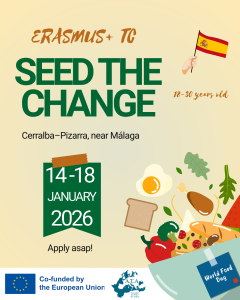
The training course  aims to strengthen the competencies of youth workers interested in addressing sustainability, food systems, and agroecological practices within their organizations. Held from 14–18 January 2026 in Cerralba–Pizarra near Málaga, Spain, the program combines theoretical inputs, group discussions, field visits, and practical workshops to provide participants with a concrete understanding of environmental challenges and local community-based solutions. The course places particular emphasis on responsible consumption, ecological farming, and rural development, equipping youth workers with tools that can be transferred to their professional contexts.

Accommodation will be provided in a basic communal facility, where all participants will sleep together in a mixed shared room equipped with beds or bunk beds, and with five shared showers available according to an organized schedule. Meals—breakfast, lunch, and dinner—will be delivered by local catering and served on-site, with attention given to dietary needs. Participants are required to contribute a 20 EUR participation fee, which supports the involvement of local producers and the quality of the practical activities. Travel costs are reimbursed according to Erasmus+ distance bands, after all original tickets and documents are submitted, in approximately 1 – 2 months after the project.

Participants are also required to prepare a short presentation about their sending organization, its work, and its local context, which will be shared during the first sessions of the training. The programe also includes an intercultural night, during which each country group is invited to present aspects of their culture through food, stories, music, or other creative elements they wish to share. This evening serves both as an informal learning opportunity and a way to strengthen group cohesion. Overall, the course is designed for youth workers and facilitators who seek to deepen their practical knowledge of sustainability while engaging in collaborative learning within a rural environment. Clear logistical instructions, preparation tasks, and guidance are provided to ensure a smooth and productive experience. Apply here asap!

0

News

From 17–22 November, Cristuru Secuiesc hosted an international Erasmus+ seminar, bringing together youth workers from France, Hungary, TĂŒrkiye, Spain, Croatia, Bulgaria, Portugal, Lithuania, and Poland. Together, we worked on finding solutions to the challenges we all face and explored new perspectives and practical approaches to participant selection, preparation, and long-term commitment.

Over the course of six days, we learned a great deal from one another. We shared the experiences of our organizations, openly discussed the difficulties we encounter, and worked together to identify methods that truly work in practice. Our conversations often took unexpected directions, and in the end, we explored many more topics than we had originally planned.

Alongside the professional outcomes, the human connections we built were just as important to us. During the week, new partnerships began to take shape, common project ideas were born, and, even more importantly, new friendships were formed. Once again, we were reminded that Erasmus+ is not only about projects, it is about people, trust, and building long-term communities.

Of course, our work does not end with the seminar. We are currently preparing a booklet that will bring together the methods, ideas, and good practices developed throughout the week. We can’t wait to share it with you, as our goal is for these results to support not only the participating organizations but also any youth worker or organization looking to engage young people in Erasmus+ projects in a more conscious and effective way.

Thank you to all our partners for your active participation, openness, honest reflections, and the inspiration you brought to this seminar!

0

News

Between November 25 and 26, 2025, Cristuru Secuiesc hosted the final conference of the YouthINC project, bringing together international partners, local youth, educators, and community representatives. The event marked the conclusion of a two-year journey dedicated to discovering invisible local heroes and empowering young people to think critically about inclusion, memory, and community impact.


🌍 Day 1 – International Partner Meeting

On November 25, representatives from Hungary, Germany, Albania, Kosovo and Israel met in Cristuru Secuiesc for the final transnational partner meeting.
The agenda included:

  • reviewing the last administrative and methodological steps
  • evaluating the overall impact of two years of cooperation
  • discussing how the MAKIVI Action and PBL methodology worked in each country
  • preparing the final dissemination tasks and possible future opportunities and ideas


đŸŽ™ïž Day 2 – Roundtable Discussion and Workshop

The roundtable began with a short introduction of all participants, followed by a structured discussion built around key reflective questions connected to the YouthINC project. The conversation offered deep insights into how communities define “heroes,” why some remain invisible, and how the project shaped young participants.


During the roundtable, participants shared what they had learned while discovering local heroes: that communities are full of diverse, often unnoticed individuals whose quiet contributions shape everyday life. They reflected on how we choose heroes, usually based on community needs and shared values and noted examples of local recognition traditions.


Partners also highlighted how the project strengthened young people’s technical and social skills, as well as their confidence to take action. The discussion touched on everyday, unrecognized heroism found in families, caregivers, or community helpers, and how social context influences who is celebrated. Participants also explored why many heroes remain invisible from safety concerns to lack of awareness, limited recognition circles, or simple jealousy. The roundtable closed with the shared belief that discovering heroes should continue: through more exhibitions, youth activities, and ongoing documentation that keeps these stories alive.

Workshop Connection

Following the roundtable, the workshop reinforced these themes through:

  • a P4C (Philosophy for Children) “Belief Bingo”, opening discussion about values and assumptions
  • a dialogue on the qualities that make life meaningful
  • an artistic activity where participants drew a “hero” and gave them visual traits that represent what society expects or admires


These activities helped deepen critical thinking about inclusion, heroism, and the many forms that community contribution can take.


đŸ›ïž
Public Conference & Heroes Exhibition

In the afternoon, we welcomed community members, representatives of local institutions, educators, youth workers, decision-makers and anyone interested in the project and our general work during the year.


The public conference presented all project results, the findings of the MAKIVI Actions, the process of creating digital monuments and the learning journey of young participants.


On the picture you can see one of our local hero, Zsuzsanna VĂĄri

Visitors then had chance to explore the Local Heroes Exhibition, where the stories collected by youth were displayed through posters, descriptions, and QR codes leading to the digital monuments published on IZI.TRAVEL. The exhibition allowed the community to finally meet the people whose quiet, consistent work shapes everyday life.


Thank you to all partners, youth participants, and community members who brought YouthINC to life.

0

News


Between 10-14 November 2025 in Szentendre, coordinated by the VĂĄci SZC Petzelt JĂłzsef Technikum Ă©s SzakkĂ©pzƑ Iskola, the three-year cooperation of six European countries – Hungary, Romania, Lithuania, Italy, Slovakia, and Portugal – started within the framework of the “Awareness of Children’s Rights in Secondary Education – Through Escape Rooms” Erasmus+ project.

The aim of the programme is to make children’s rights understandable and experiential for young people using modern, experience-based methods, especially through the creative and interactive tools of escape rooms.

The teachers and professionals participating in the project became familiar with the common objectives, the responsibilities of each country, and the main milestones of the three-year work plan already on the first day of the meeting.

Escape rooms are a complex yet highly attractive method for young people: they introduce the world of children’s rights in a playful form while developing teamwork, creativity, and problem-solving skills.

First steps of the joint work:

The participating teams arrived on Sunday afternoon at the Mathias Rex guesthouse in Szentendre, which welcomed them with a calm, homely atmosphere. Monday began with a rich breakfast and informal conversations, followed by the official opening where the Hungarian Education Chancellor greeted the international team. The leadership of the Petzelt JĂłzsef Technikum and the key professional partners involved in the implementation of the project were also present at the event.

In the morning the online platform designed for sharing project materials and tasks was introduced. After an overview of children’s rights, the participants tried the first escape room, created on the basis of “The definition of a child” (Article 1 of the UN Convention on the Rights of the Child). The experience, containing quizzes, code-breaking tasks, and playful puzzles, served as inspiration for all countries for the further creative process.

Joint creation – designing escape rooms:

Tuesday was spent in a calm, creative atmosphere: each country began developing its own tasks in smaller groups. The aim was for the partners to contribute unique and inventive elements to the escape room collection being developed. In this spirit, participants worked with the keywords of the 28th children’s right – the right to education (e.g. support, education, equality) – and created new tasks based on their own professional experiences.

On Wednesday the teams presented their completed tasks to each other, and there was also an opportunity to try them out. In the second half of the day the voting for the project’s official logo took place – out of several excellent submissions, the Romanian team’s design received the most votes.

Testing the escape rooms with local students:

The highlight of Thursday’s programme was the practical testing of the tasks. Ten students from the Petzelt JĂłzsef Technikum Ă©s SzakkĂ©pzƑ Iskola participated in the testing, providing real feedback to the teachers on how young people respond to the games they created. The students’ enthusiasm confirmed that the project is heading in the right direction and that the method is indeed suitable for developing children’s rights awareness.

In the afternoon the participants set out to explore Budapest, visiting Buda Castle and the House of Terror Museum. The cultural programme not only enriched the team with historical knowledge but also provided opportunities for informal conversations and for deepening international connections.

Looking ahead: 42 escape rooms in the service of children’s rights!

During the project a total of 42 escape rooms will be created – both in online and offline form – which will be freely available for students and teachers to try in their own institutions.

The emphasis throughout is on collective thinking, creativity, and sharing experiences. It is hoped that by the end of the three-year cooperation a complex pedagogical toolkit will be created that effectively supports schools in teaching children’s rights.

Authors: Melinda Kornis and BorbĂĄla Nagy, teachers of the Zeyk Domokos Technological Lyceum.


0

News

Are you ready to build a healthier, more relaxed relationship with food and with yourself? Then join Eat with Confidence, an inspiring Erasmus+ youth exchange taking place from 30 January to 5 February 2026 in the cozy village of Palárikovo, Slovakia. During this week-long adventure, you’ll explore how to enjoy food without guilt or pressure. Guided by a friendly nutritionist, participants will learn how to listen to their bodies, understand hunger cues, and discover that food is not just about calories — it’s about joy, culture, and connection. 

You’ll meet young people from Slovakia, Spain, Portugal and Hungary, forming an open-minded community where everyone can share experiences, challenge stereotypes, and learn together. Don’t worry if your English isn’t perfect — this is a safe and supportive space where communication, laughter, and friendship matter more than grammar!đŸ€Travel costs will be reimbursed up to 417 € and all accommodation, meals, and activities are fully covered — just make sure to apply by 20 November 2025 here.


0

News

Every Erasmus+ project starts with one important step: finding the right participants.

It sounds simple, but anyone working in youth work knows that it rarely is. Sometimes we receive far more applications than available places. Sometimes the information never reaches the young people who would benefit the most. Sometimes motivation fades during the long preparation process, or participants drop out just before the mobility begins. And one of the biggest questions remains the same: how can we help young people truly feel that the project is theirs? These are challenges we all face, regardless of the country we work in. That is exactly why, this November, we are creating a space where youth workers can think, learn and develop solutions together.

From 17–22 November, we will host an international Erasmus+ Seminar on Selection & Participant Commitment, welcoming youth workers and project coordinators from France, Hungary, TĂŒrkiye, Spain, Croatia, Bulgaria, Portugal and Poland. During the week, we will reflect on the recurring challenges of participant selection and drop-outs, explore the psychological, cultural and practical factors that influence motivation, and share recruitment methods that have proven successful in different organisations and countries.


Together, we will develop practical resources such as common selection checklists, commitment-building strategies and preparation tools that can be used by all partner organisations in future projects. We will also dedicate time to planning new mobilities and strengthening our international partnerships.


Of course, no ATA seminar would be complete without experiencing our local community. Alongside the professional programme, participants will discover Sighișoara, enjoy intercultural evenings, exchange stories, play games, and hopefully leave not only with new ideas but also with new friendships.


For us, this seminar is about much more than just improving selection processes. It is about creating learning experiences where young people feel ownership, responsibility and motivation from the very beginning. If we can prepare participants better, we can create even more meaningful Erasmus+ experiences for everyone involved. We are looking forward to welcoming our partners and spending an inspiring week learning from each other.

Follow us to see what we discover together, you might find some ideas worth bringing to your own community!

0